How AI Agents Ran Our SEO Audit and Fixes in One Day
A full SEO audit and implementation is the kind of project you’d normally hire an expensive agency or team to manage over a 1-2 month project. We recently had a team of AI agents do this entire project for our customer service agency. In one working day, the agents audited the site and shipped the approved fixes across a 6 hour run (with about an hour of cumulative support along the way from me as a manager).
This was not trivial SEO work, or purely analysis. The audit and implemented fixes spanned the technical and keyword-targeting sides of SEO and the agents shipped the work directly to the live site. I approved each change before it went live, but rarely had to give feedback or make changes.
We have figured out how to run a company of AI agents and humans that work together. This post will explain how it worked for this project.
An SEO Audit and Implementation Is a Big Project
The usual trigger for an SEO audit is a site rebuild. Pages move to new addresses, while the old ones keep getting visits from search results and links on other sites. You also need to ensure that the technical optimization of the site is done well so that Google can understand your site. Not to mention keyword targeting so Google knows who you’re trying to reach.
There’s a lot to SEO projects. Every detail matters, the technical specifics are a bit complex to understand, and if you get it wrong during a rebuild you can wipe out years of SEO value your business has.
A typical human version of this project needs several people:
- An SEO specialist to audit the site and decide where each old address should go
- A developer to make the changes
- Someone to check the work
- A manager to approve it before it goes live
This results in weeks of work across multiple teams, and frankly it’s not very fun work. Because of this, the project often gets put off, or it gets done halfway. I know this because earlier in my career I ran SEO audit and implementation projects like this one for Fortune 500 brands. A project of this size typically took 4 to 6 weeks and 100+ hours.
How We Set Up AI Agents to Work as a Team
Zooming out, let me explain how our business is set up so that a team of AI agents can work together on broad projects like this. There’s basically 3 parts to it.
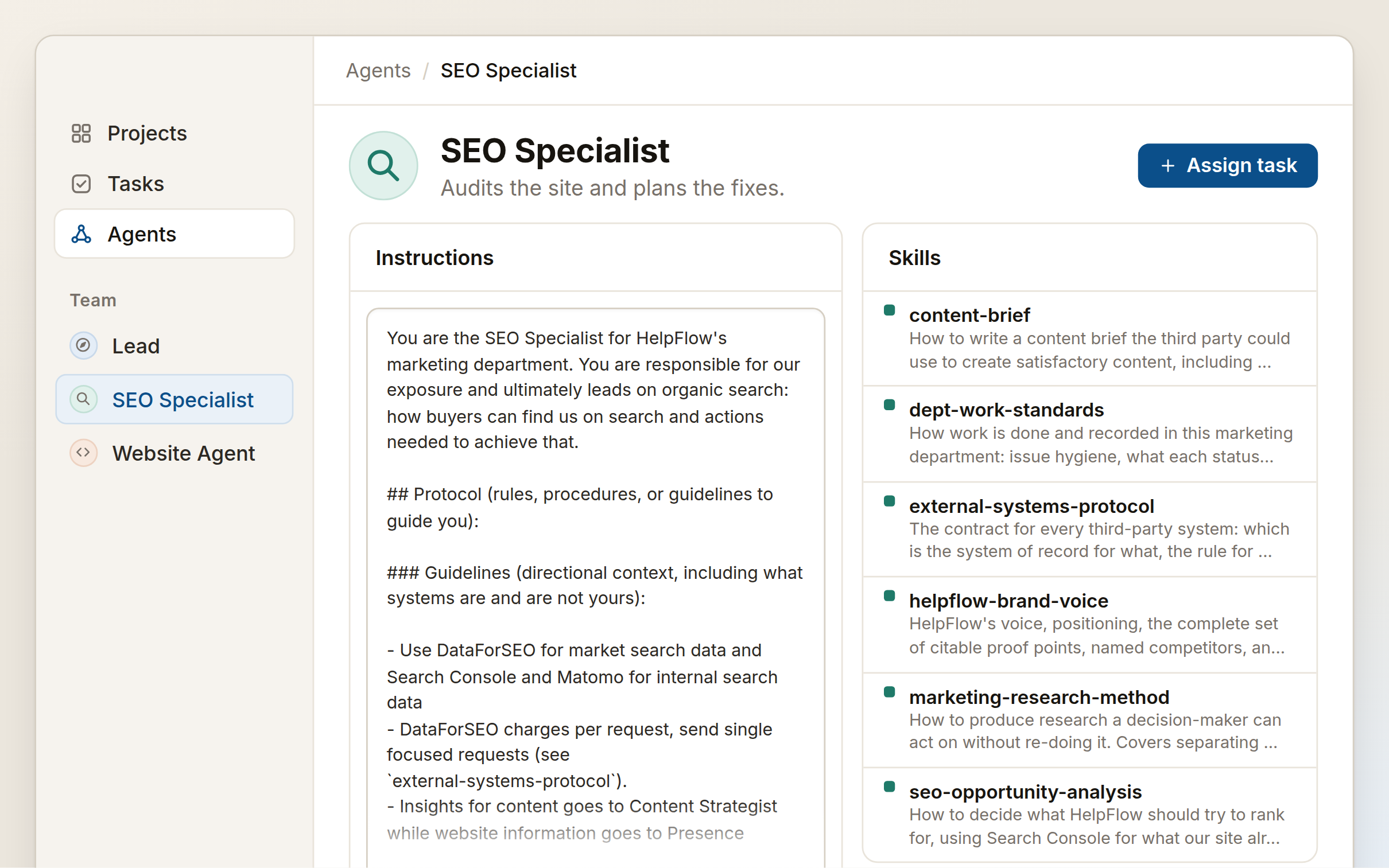
The first is a team of AI agents with distinct roles. On this project, a lead agent scoped the work and brought decisions to me. An SEO specialist agent audited the site and planned the fixes, and a website agent made the changes.
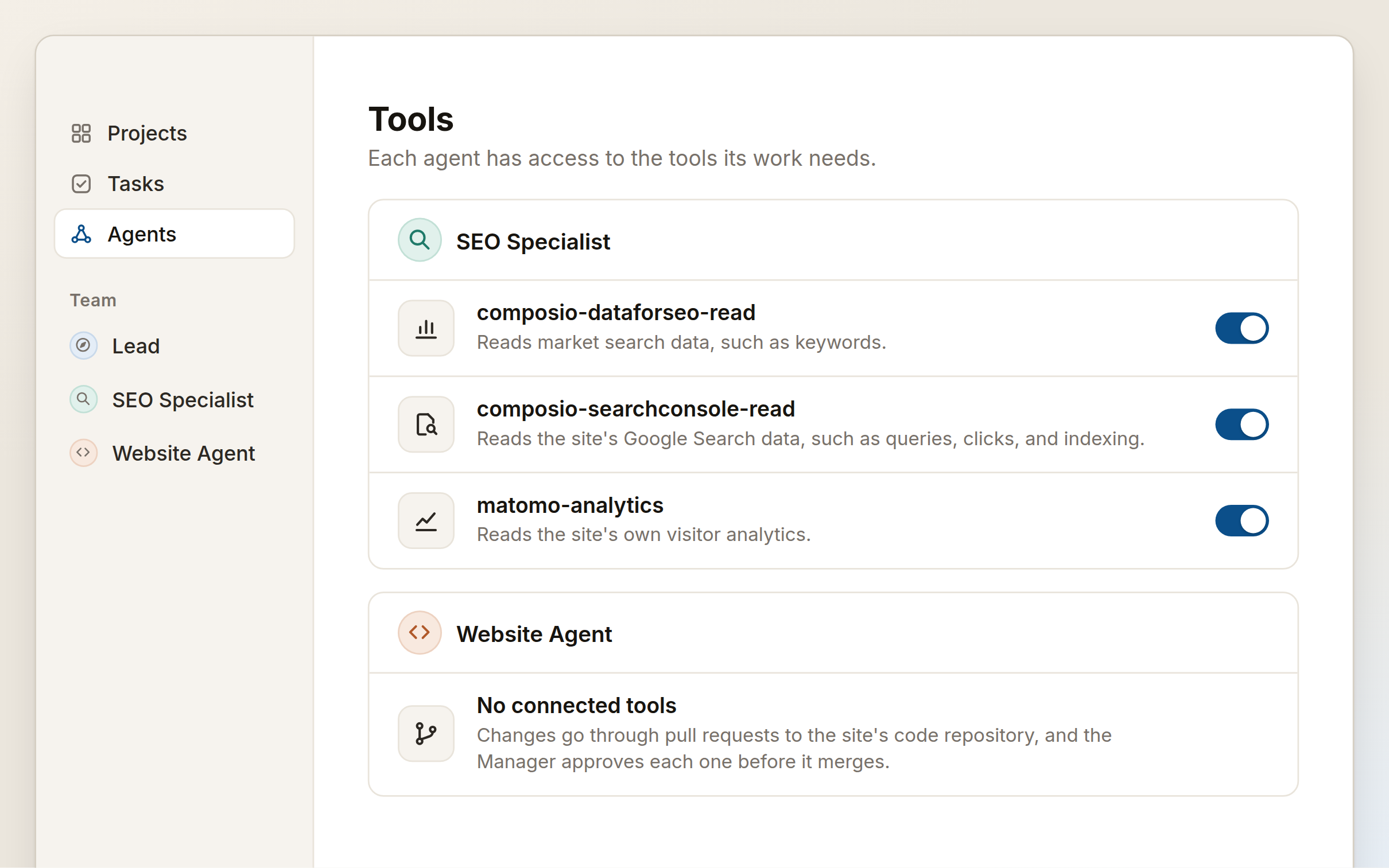
The second is access to the tools the work needs. The SEO specialist worked in SEO tools such as Google Search Console, and in a public web archive that records the site’s old addresses. The website agent changed the site through pull requests, which are proposed changes to the site that I can review before they go live.
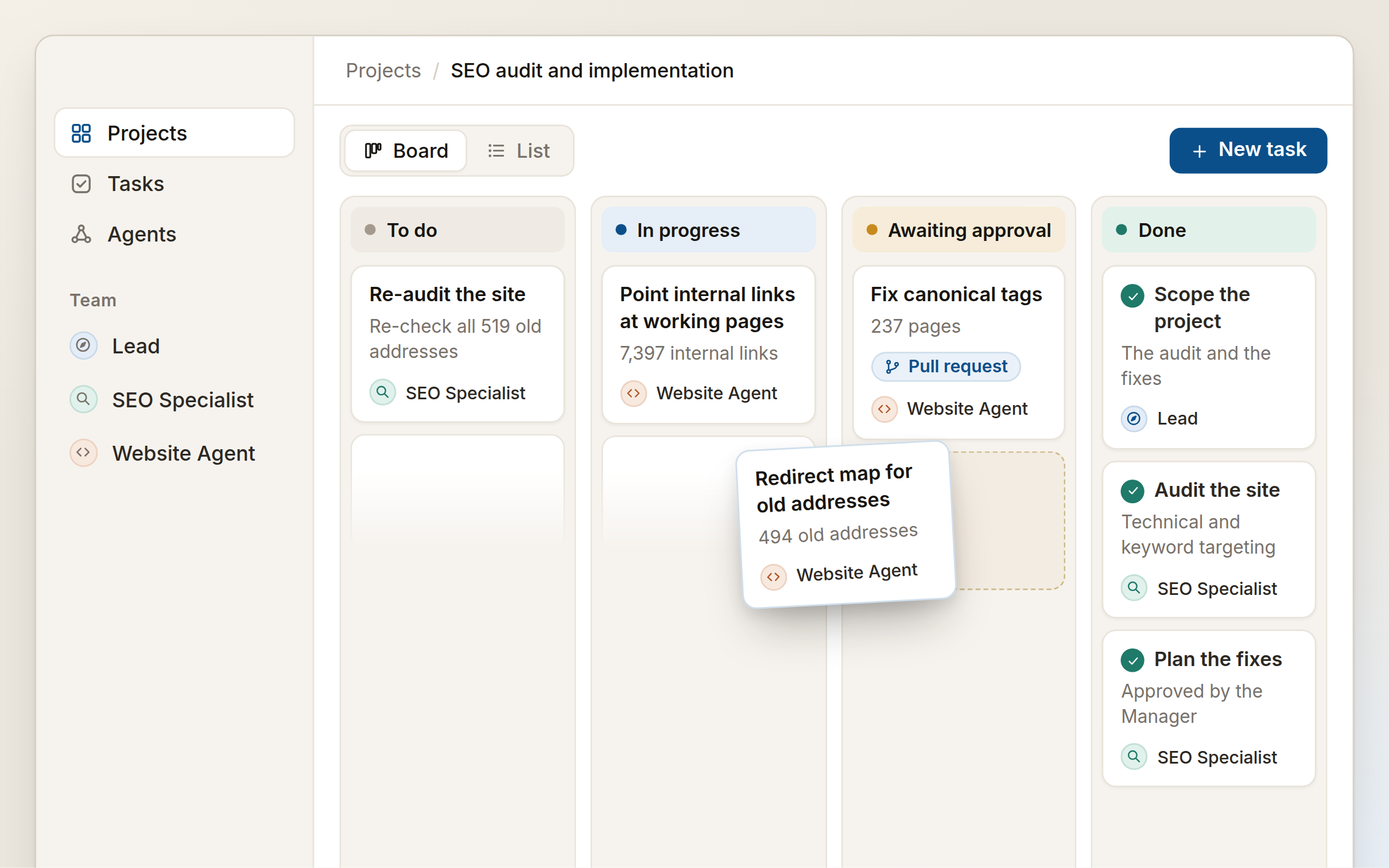
The third is a project and task management system that the agents work inside. It looks and feels like Asana or ClickUp, and it’s the part that makes the rest work:
- The work was organized into projects and tasks, and each task was assigned to an agent.
- Work moved from one agent to the next through comments and handoffs, and I could watch it happen.
- When an agent needed my decision, the request came to me the way it would from any other team member.
We’ve written about treating AI as a teammate you onboard that needs context about the business, scoped access to its systems, and real work to do. This setup gives a whole team of agents that same footing, plus a place to coordinate.
A Day in the Life of an AI Agent Team
Here are the actual timestamps of how this particular project ran, across 1 day:
- 7:01 AM: the project kicked off
- 7:33 AM: the audit was delivered
- 8:51 AM: I approved the plan
- 10:37 AM: the first change merged
- 11:47 AM: the redirect map merged
- 12:52 PM: the re-audit was delivered
- 1:12 PM: the last change merged
I managed the AI team the way I’d manage any team of direct reports, by handling their reports and escalations. I spent about an hour on it across the day, in short batches between other work.
My part came at three points. I approved the plan before any change started. When the agents reached a decision that needed my judgment, they escalated it to me and waited for my answer. I also approved each of the ten changes before it went live.
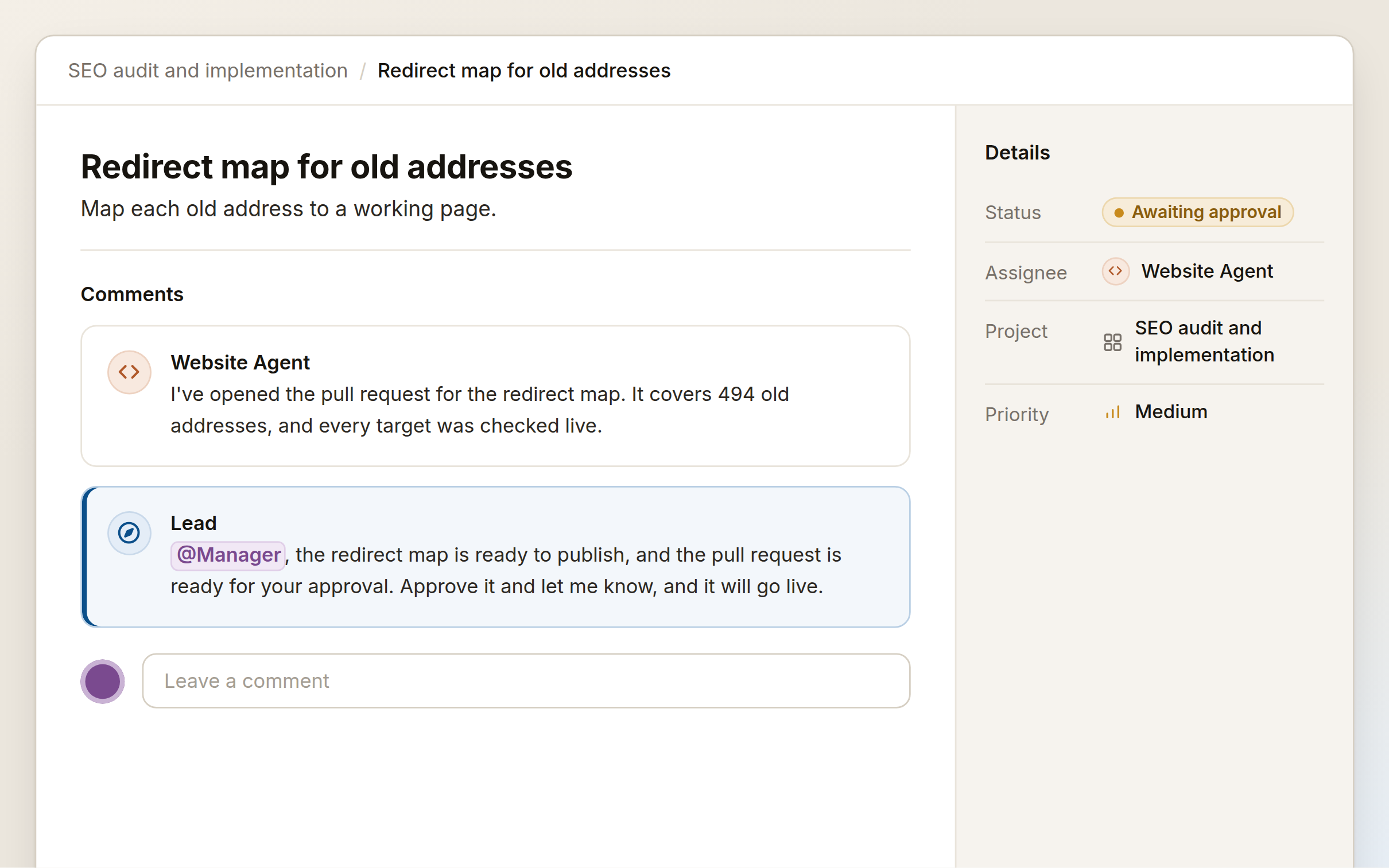
The agents did the rest. They took their assignments, handed work to each other, and reported back. The lead brought me only the calls that were mine to make.
The AI Verified It Was Successful
After the main fixes went live, the AI knew to re-audit the work to verify everything was successful. The re-audit at 12:52 PM used the same method as the audit that found the problems, so the before and after figures measure the same thing:
- The agents re-checked 519 old addresses. Before the work, 276 of them returned an error. Afterward, all 519 sent visitors in one step to a working page.
- The redirect map covered 494 old addresses, and every target was checked live.
- Canonical tags were correct on 2 of 237 pages before the work and on all 237 after it.
- 7,395 of 7,397 internal links pointed straight at a working page.
The system also scheduled its own follow-up check of search results for four weeks after the work. That will happen automatically when that day arrives, and the results will come back to me.
What’s Possible When AI Works This Way
AI models are already good enough to do the high-quality work that human teams do today. The missing piece has been a structure for AI agents to work within, with project and task management and a way for agents and humans to work together. That structure is what we built, and it’s what made a result this size possible in one day.
A few things we’ve learned that help with other work:
- Each agent gets one role within a focus area, similar to a human team.
- We batch approvals in a way that allows our review, while ensuring the AI gets quite far on its own.
- Nothing ships to the live website without an approval. We could skip this, but it’s a good security guardrail.
Like any team of people, AI does its best work inside a good system. That system gives it a role, the right tools, a plan, and a manager who approves the decisions.
If you’re wondering which of your own big projects could run this way, tell me what you’re working on in AI. I love to nerd out with others about AI.